



Global Training Delivery & Contract Trainers for Large-Scale Rollouts
Delivering training across multiple locations, countries, and time zones creates significant challenges for training companies. Large-scale system implementations, technology rollouts, and organizational transformations often require qualified instructors in different regions, tight scheduling coordination, and consistent delivery standards.
TrainingFolks helps training providers scale their global training delivery through our network of over 30,000 learning professionals. From enterprise system rollouts involving SAP, Salesforce, Workday, and other technologies to company-wide transformation initiatives, we provide experienced contract trainers and facilitators who work alongside your teams to support your clients' training requirements.
Our managed learning services and global training delivery capabilities extend beyond sourcing instructors. We can support trainer onboarding, scheduling, travel coordination, delivery management, and reporting, helping you execute complex training programs while maintaining quality, controlling costs, and meeting client commitments.
Frequently Asked Questions
Training companies can expand delivery capacity by combining a core internal team with contract instructional designers, eLearning developers, trainers, and project managers who support client engagements as needed.
This approach is particularly useful when project volumes fluctuate. A major client win may require several instructional designers for six months, while a nationwide rollout might need dozens of trainers for only a few weeks. Maintaining those resources permanently can create unnecessary costs between engagements.
The key is to plan staffing around confirmed project requirements, anticipated workloads, and the skills needed at each stage. Establishing relationships with qualified staffing partners before projects begin can also reduce the pressure of finding specialized talent at short notice.
TrainingFolks provides learning and development staffing services that help training providers access additional expertise and delivery capacity without expanding permanent teams for every project.
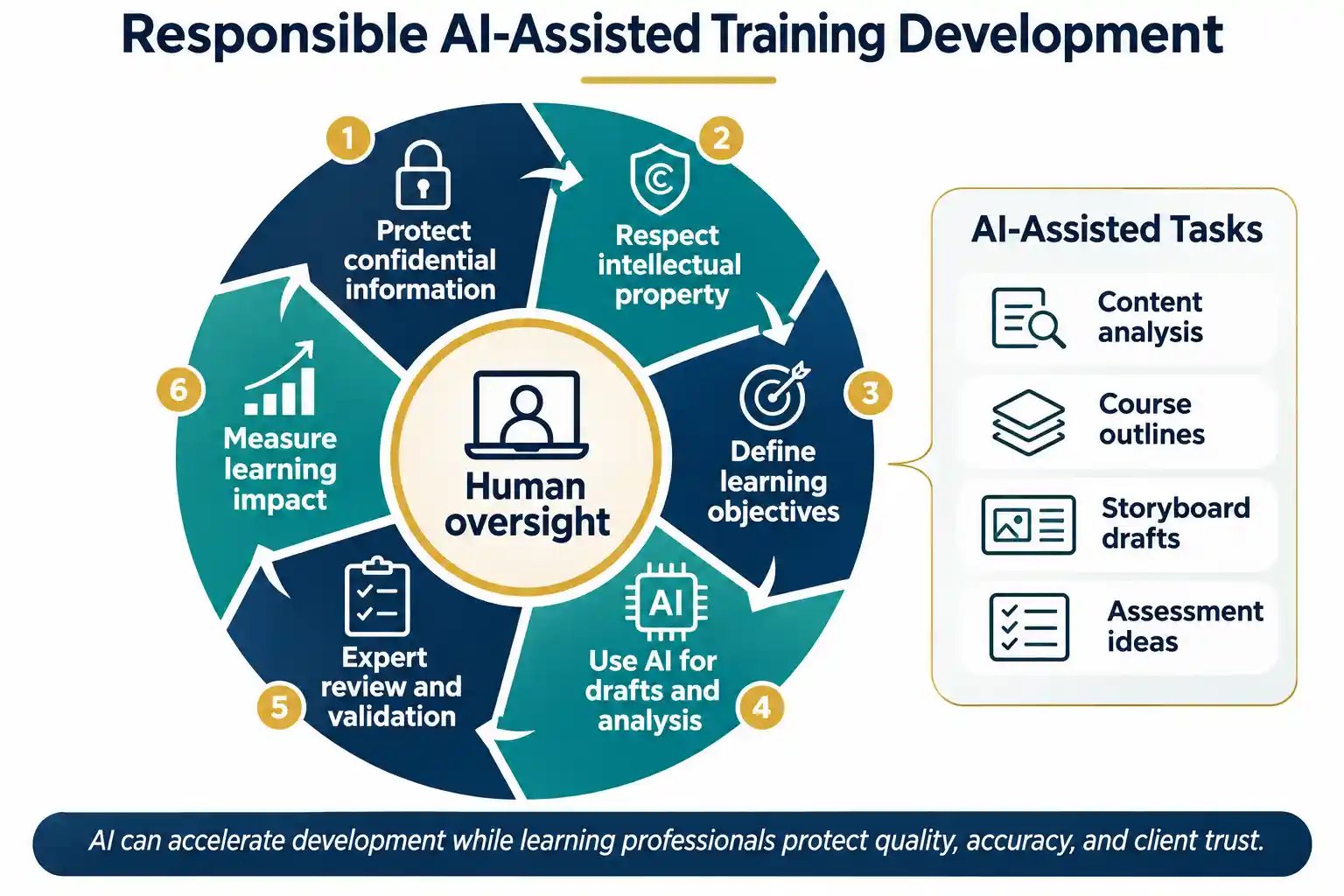
AI can help training companies accelerate several stages of instructional design and eLearning development, including content analysis, initial course outlines, storyboard drafts, assessment questions, and the adaptation of existing learning materials.
However, faster content production does not automatically produce better training. Experienced instructional designers are still needed to establish learning objectives, evaluate content accuracy, design meaningful practice activities, and determine whether the finished program meets the client's requirements.
Responsible AI use is equally important. Training providers should establish clear policies for protecting confidential client information, respecting intellectual property, reviewing AI-generated content, and using only tools approved for the project. Human review should remain part of the development process.
The following framework illustrates how AI-assisted development can improve efficiency while maintaining human oversight, instructional quality, and client trust.
For training companies without sufficient internal AI expertise, engaging learning professionals experienced in AI-assisted development can help introduce more efficient workflows while maintaining instructional standards and client trust.
Training companies can source contract instructional designers and eLearning developers through professional networks, industry associations, referrals, and specialized learning and development staffing firms.
The challenge is finding professionals whose experience matches the actual assignment. An instructional designer developing leadership training may need different capabilities from someone creating technical simulations, software training, or complex digital learning programs.
Before engaging a contractor, review relevant work samples, experience with authoring tools, instructional design methods, and the ability to collaborate with client subject matter experts. For larger projects, confirm availability, project management expectations, and familiarity with the client's development standards.
TrainingFolks helps training providers find contract instructional designers and other learning professionals suited to their project requirements, whether they need one specialist or additional resources for a larger development initiative.
Protecting project margins starts with understanding the relationship between staffing costs, utilization, project scope, and delivery commitments.
Maintaining too many permanent resources during slower periods can reduce profitability. Relying too heavily on last-minute contractors, however, may introduce higher costs, inconsistent quality, or delays.
A balanced approach is to retain core capabilities internally while using qualified contract professionals for specialized work, peak production periods, and large client implementations.
Training providers should also monitor project profitability throughout delivery, not just during the proposal stage. Tracking resource utilization, development hours, scope changes, and contractor costs can help identify problems before they affect margins.
Flexible staffing is one way to manage these pressures, particularly when supported by reliable resource forecasting and established contractor relationships.
Global training delivery requires more than identifying instructors in different locations. Successful programs depend on coordinated scheduling, trainer preparation, consistent instructional materials, local delivery requirements, and reliable communication across regions.
For example, an enterprise software implementation involving SAP, Workday, Salesforce, or another business platform may require instructors to deliver role-specific training across several countries within a tightly controlled rollout schedule.
Training companies should establish common delivery standards, confirm trainer qualifications, coordinate materials and schedules, and provide clear escalation procedures when problems arise. Regional language requirements, time zones, travel logistics, and virtual delivery capabilities also need to be considered.
TrainingFolks supports large-scale programs through its network of contract trainers and Managed Learning Services. These capabilities can help training providers coordinate instructor resources, delivery schedules, and training operations across multiple locations.
Maintaining consistent training quality begins before an instructor enters the classroom. Contract trainers need clear expectations, appropriate preparation, access to approved materials, and an understanding of the client's audience and delivery standards.
For large programs, training companies can use standardized facilitator guides, trainer onboarding sessions, practice deliveries, and observation checklists to establish consistency. This is particularly important when several instructors deliver the same program across different locations.
Quality should also be monitored during delivery. Participant feedback, instructor observations, client evaluations, and escalation records can help identify where additional coaching or adjustments are required.
When selecting contract trainers, training providers should assess not only subject knowledge and facilitation experience but also communication skills, professionalism, and the ability to represent the client's organization effectively.
Training companies can outsource a wide range of learning and development roles, depending on the services they deliver and the capabilities available within their internal teams.
Common contract roles include instructional designers, eLearning developers, curriculum developers, classroom trainers, virtual facilitators, training coordinators, LMS administrators, learning project managers, and change management professionals.
Some roles support a defined deliverable, such as developing a new course. Others support ongoing operations, including scheduling instructors, administering learning platforms, managing training records, or coordinating large client programs.
The decision to outsource should consider project duration, required expertise, available internal capacity, and the level of coordination needed. TrainingFolks offers access to specialized learning professionals, including training coordinators and LMS administrators, who can complement a training provider's existing team.
Training companies should evaluate staffing partners on their ability to identify qualified learning professionals, respond to changing project requirements, and support consistent delivery without disrupting existing client relationships.
A strong partner should understand the differences between instructional design, eLearning development, training facilitation, learning technology, and project management roles. Access to a large talent network is valuable, but the quality of screening, role matching, and ongoing communication matters just as much.
Before selecting a provider, ask how candidates are evaluated, how quickly resources can be identified, how replacement needs are handled, and what support is available for multi-location engagements.
It's also important to clarify responsibilities for project management, quality assurance, confidentiality, and client communication.
TrainingFolks works with training companies and learning consultancies to provide qualified learning professionals who support their existing teams, delivery processes, and client commitments.

Role Based Training Approaches for System Implementation Projects
Role Based Training Approaches for System Implementation Projects System implementation projects require employees to learn new processes, tools, and workflows. A common challenge is delivering traini…

How Contract Trainers Support Large Scale Training Rollouts
How Contract Trainers Support Large Scale Training Rollouts Large scale training rollouts are often required during system implementations, organizational changes, or enterprise wide initiatives. Thes…

Key Questions Before Outsourcing Instructional Design
Key Questions Before Outsourcing Instructional Design Outsourcing instructional design can help organizations expand training capacity, improve course quality, and move important learning projects for…